
Key Takeaways
- Packing dishes for moving comes down to two goals: preventing items from shifting and absorbing shock around each piece.
- Plates travel on their edges like records because they are structurally stronger standing upright than lying flat.
- Every dish box needs a paper cushion at the base, individual wrapping, and enough fill so nothing moves when you shake the box.
What Do You Need to Pack Dishes for Moving?
Anyone learning how to pack dishes for moving needs dish packs or double-walled boxes, clean packing paper, bubble wrap, cardboard dividers, packing tape, and a marker. Gathering everything first prevents mid-pack improvising, where most breakage starts.
- Dish packs or double-walled boxes: stronger than standard boxes and built to withstand the weight of kitchen items.
- Clean packing paper: newspaper ink transfers onto dishes, and the paper can tear easily.
- Bubble wrap: the layer that matters most for stemware and heirloom pieces.
- Cardboard dividers: cells that keep glasses and mugs from touching.
- Packing tape: for reinforcing the bottom seam and the openings.
- Permanent marker and fragile labels: for marking several sides of each box.
First, tape the bottom seam before you put anything in. Dishes weigh more than they look, and a weak base is one of the fastest ways to lose a box.
Booking a crew early matters too, call Above and Beyond Moving and Storage! We work across Ann Arbor, Northville, Novi, and the rest of Southeast Michigan.
How Do You Pack Dishes for Moving, Step by Step?
Packing dishes for moving comes down to five steps: cushion the base, wrap each plate and stand it on edge, wrap and stack bowls with paper between them, pad glassware inside and out, then fill every gap before sealing. Careful packing beats fast packing every time.
| Step | What Happens | Why It Matters |
| 1 | Crumple paper across the base, two to three inches deep | Absorbs shock when the box is set down |
| 2 | Wrap plates individually, stand them on edge | Plates carry pressure better upright |
| 3 | Wrap bowls, stack with paper between each | Stops pressure transferring downward |
| 4 | Pad glasses inside and out, stand upright in dividers | Prevents caving and glass-on-glass contact |
| 5 | Fill gaps, seal, label several sides | Nothing shifts, and handlers know the contents |
Step 1: Cushion the Base
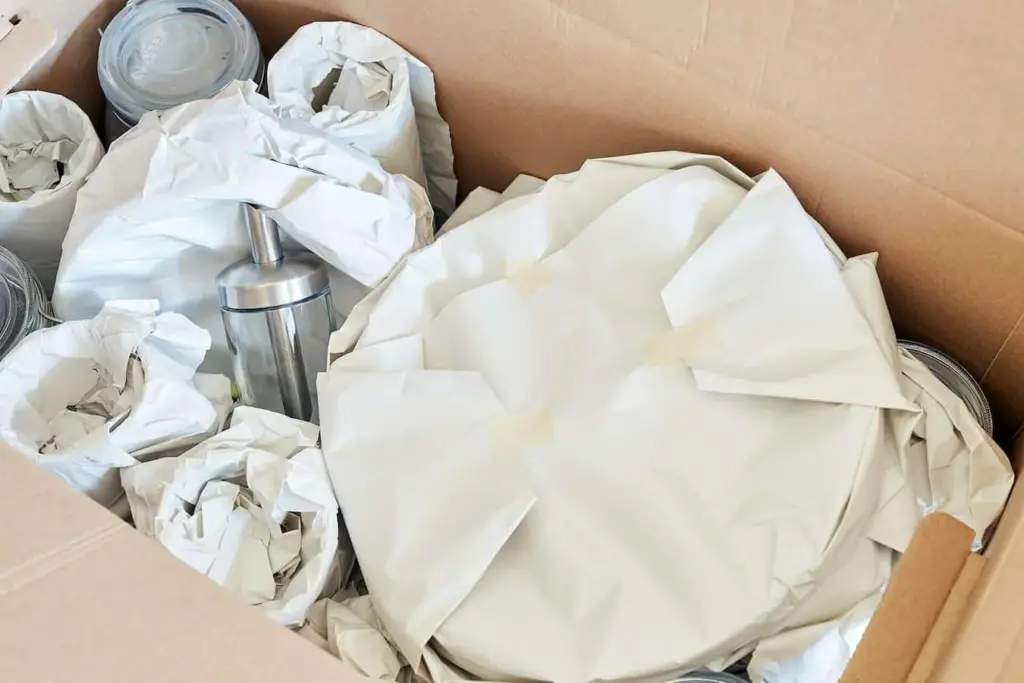
Crumple packing paper into a layer two to three inches thick across the bottom of the box. That layer absorbs the shock when a box gets set down firmly.
- Depth: two to three inches of crumpled paper, loosely packed.
- Coverage: the full base, with no dish ever touching bare cardboard.
- Before that: tape the bottom seam, since dishes weigh more than they look.
Step 2: Wrap Plates and Stand Them on Edge
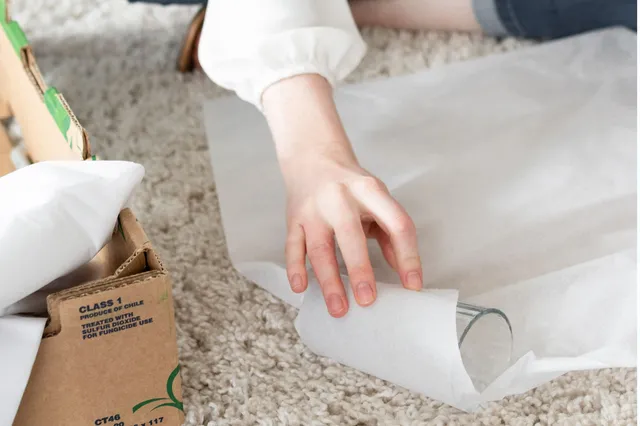
Lay one plate in the middle of a sheet of packing paper, then fold the paper around it until it’s fully covered. Thin, delicate, or sentimental pieces earn a second sheet.
Then place the plates vertically, standing on their edges like vinyl records. Plates are structurally stronger in that position, so the pressure of the stack no longer works against them.
- Wrapping: one sheet per plate, two for delicate or sentimental pieces.
- Orientation: upright on the rim, side by side across the box.
- Between plates: a layer of paper cushioning at every contact point.
Step 3: Wrap and Stack Bowls
Wrap bowls individually in paper, and stack them with crumpled paper between each one. Heavier serving bowls take a layer of paper followed by bubble wrap.
- Each bowl: wrapped on its own before it joins a stack.
- Between bowls: crumpled paper to stop pressure transferring downward.
- Serving bowls: paper, then bubble wrap, placed in the center of the box.
Step 4: Pad Glassware Inside and Out
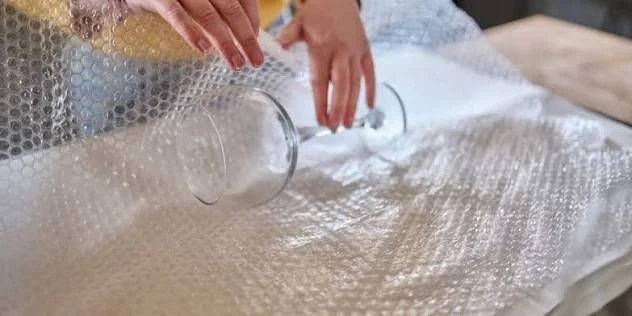
Glasses need support from within. Place a small piece of packing paper inside each glass first to keep the walls from caving. After that, bubble wrap covers the outside until the glass’s shape disappears beneath the padding.
Wine glasses and thin crystal take an extra pass, since the stem is the weak point.
- Inside first: crumple paper to fill the glass bowl.
- Stems: wrap them separately, then wrap the whole glass again.
- Placement: upright in cardboard dividers, standing clear of each other.
Step 5: Fill Every Gap and Seal
Crumpled paper fills every remaining space, with a final protective layer across the top. Close the box and shake it gently. If anything moves inside, add more padding.
- The shake test: a properly packed box feels solid, with no shifting.
- Sealing: tape the top firmly once the contents stop moving.
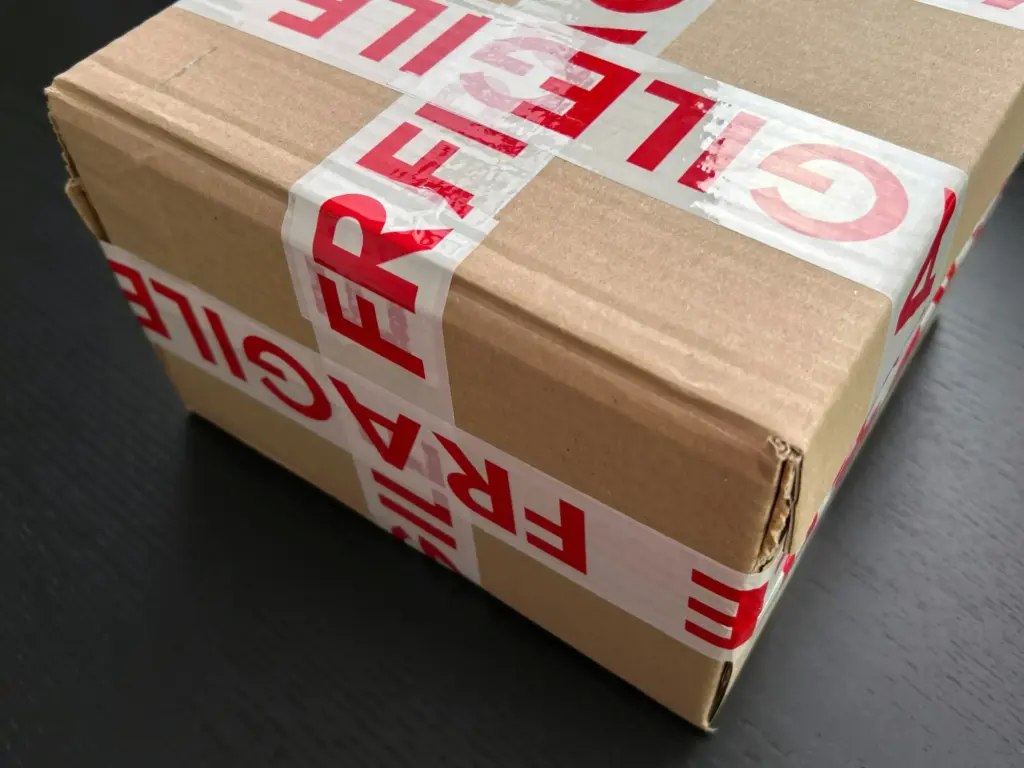
- Labeling: “FRAGILE” and “THIS SIDE UP” on several sides.
Households short on time can hand this part over. Our packing and unpacking service covers dishes, glassware, and the awkward pieces that come up in the final week.
How Do You Pack Other Fragile Items?
Artwork, mirrors, and small valuables follow the same principles, but use different containers. Framed pieces and canvas prints travel in picture or mirror boxes, wrapped in paper and then bubble wrap, standing vertically with bunched paper around every edge.
- Framed art and canvas prints: small pieces fit in a standard box standing upright, while larger ones need a telescoping picture box taped in all directions so the halves cannot slide apart.
- Corner protection: cardboard corner protectors guard the frame edges, and spare cardboard can substitute.
- Jewelry: a closed jewelry box taped shut, with soft filler added so nothing rattles inside.
- Spindly décor: paper rolled around the thin sections evens out the shape before the whole piece gets wrapped.
- Oil paintings: a moisture barrier layer sits between the surface and the wrapping.
What Mistakes Break Dishes in Transit?
Most breakage traces back to a handful of habits. Overloaded boxes, towels standing in for packing paper, single wrapping on valuable pieces, and unlabeled boxes each raise the odds of opening a box to find damage.
- Overpacking the box: if a box feels hard to lift, it’s too full, and 40 to 50 pounds is the working ceiling for a dish box.
- Substituting towels for paper: towels shift during transport, while packing paper stays put and absorbs impact.
- Single wrapping valuable pieces: adding paper now costs less than replacing an heirloom later.
- Skipping labels: boxes marked “FRAGILE” and “THIS SIDE UP” get handled accordingly.
- Weak bottom seams: reinforcing the base and corners with extra tape prevents the failure point most damage photos show.
Handling matters locally too. Ann Arbor has no official loading zones around the dorms during move-out, and standard parking rules remain in effect, so fragile boxes often travel farther by hand between the door and the truck.
Michigan winters bring wet, salted ground underfoot, making a solid base seam worth the extra tape.
How Do You Unpack Dishes Safely?
Dish boxes come off the truck early so heavier boxes never stack on top of them. Items come out one at a time, carefully unwrapped, with packing paper kept nearby for anything waiting on the unready shelves.
Inspect each piece as it emerges. Document anything damaged promptly, since insurance and moving company claims both depend on a timely record.
Request an estimate from Above and Beyond to see packing quoted alongside the move itself.
Frequently Asked Questions
What is the best way to pack dishes for moving?
Cushion the box base with two to three inches of crumpled paper, wrap each plate individually, and stand plates on their edges. Wrap bowls separately with paper between them, pad glassware inside and out, then fill every gap before sealing and labeling.
Should plates be packed flat or on their edges?
On their edges. Plates are structurally stronger standing upright, similar to vinyl records, which spreads pressure across the rim. Lay them side by side with paper cushioning between each one, and the stack no longer presses down on the plates below.